Short answer
For a first visit, stay in or right next to the Old Town, in Pile or Ploče, so you can walk to the sights and the city beach at Banje. For a beach holiday, choose Lapad or Babin Kuk, west of the Old Town, where many of the city's hotels, the Lapad Bay promenade and family beaches such as Copacabana are, with city buses to Pile Gate. Gruž, the port district, is the practical choice if you are catching ferries to the islands or buses out of the city. Cavtat, a separate town outside Dubrovnik, is much closer to the airport and connected to the city by bus and by boat.
| Area | Best for | Getting to the Old Town | Beaches nearby |
|---|---|---|---|
| Old Town | First visits, sightseeing | You are already there | Gornja Buža, Donja Buža, Porporela (rocks) |
| Pile | Walking access, bus connections | Walk through Pile Gate | Šulić, Danče |
| Ploče | Walking access, the city beach | Walk through Ploče Gate | Banje (pebble), Sveti Jakov (pebble) |
| Lapad | Beach holidays, families, promenade | City bus to Pile | Lapad Bay (pebble), Copacabana (gravel) |
| Babin Kuk | Larger hotels | City bus line 6 to Pile | Copacabana, Cava |
| Gruž | Ferries, buses, the morning market, lower prices | City bus to Pile | None on the Tourist Board's list |
| Cavtat | Quieter stay, close to the airport | Bus line 10 (EUR 4.00) or boat | Outside Dubrovnik's beach list |
| Elaphiti Islands | Peace and sandy beaches | Public boat to Gruž | Šunj on Lopud, Gornje and Donje Čelo on Koločep |
1. The Old Town
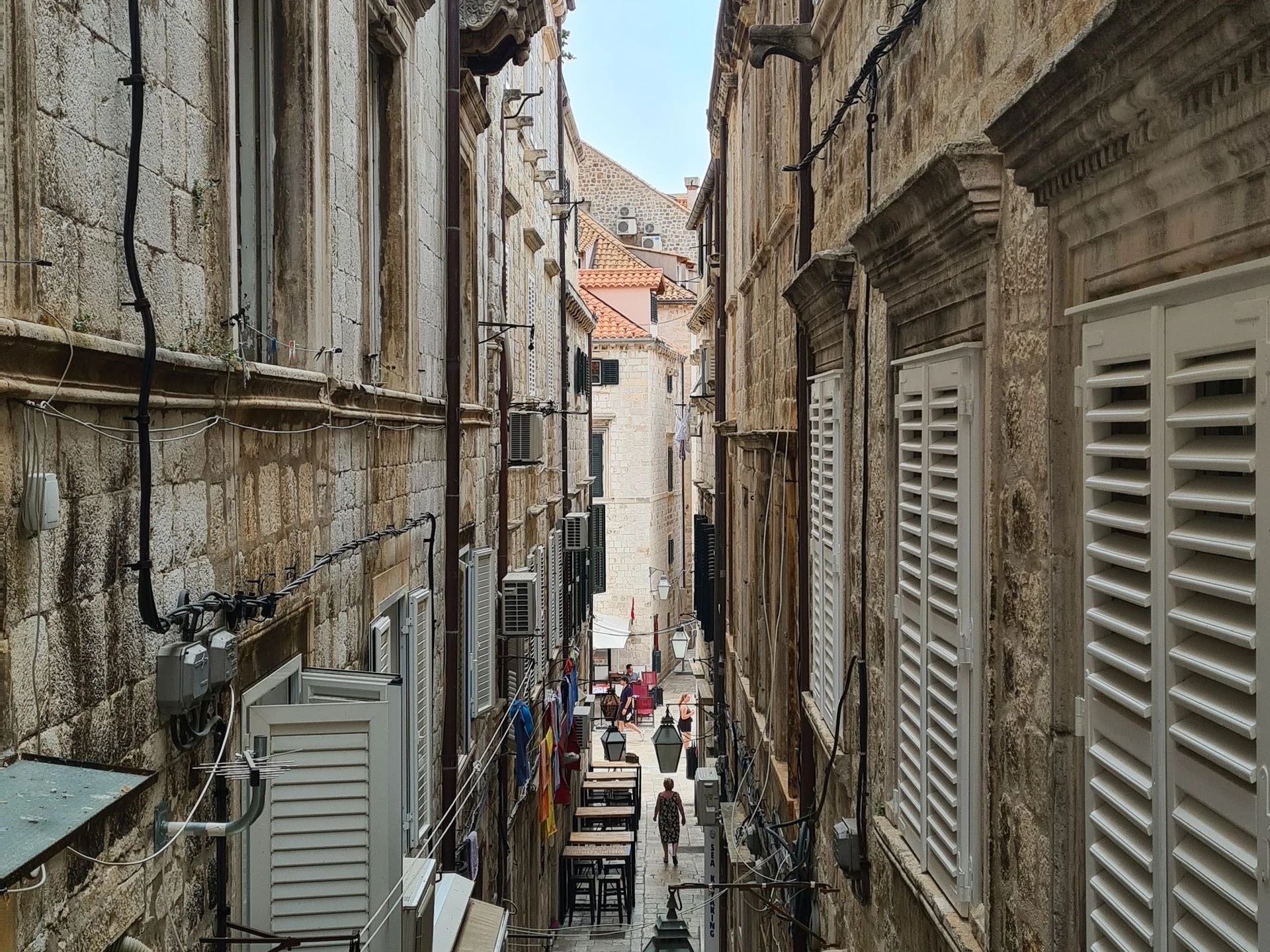
Staying inside the walls puts you next to everything in our answer on things to do in Dubrovnik Old Town. It also has practical limits. The Old Town is a pedestrian zone, so a taxi drops you at Pile Gate or Ploče Gate and you walk the rest of the way with your luggage. Vehicle access to the historic centre is restricted to a special traffic regime zone, and only guests with prior registration or accommodation that includes parking can drive in.
In summer the Old Town is lively in the evening, but city rules keep outdoor music at bars and restaurants to between 18:00 and 23:30, and music must not be heard outside a venue from 23:30 to 10:00. The Mayor can allow longer hours for special events.
Local tip: the Old Town gets quiet after midnight, apart from rare special occasions such as the opening night of the Dubrovnik Summer Festival.
Local tip: many Old Town apartments are reached by long flights of stone steps. Before you book, check the route from the nearest gate on Google Street View, not only the distance on the map.
2. Pile and Ploče, just outside the walls
Pile, at the western gate, is where most city bus lines end, including lines 1A, 1B, 2A, 3, 4, 6, 9 and 17. Šulić and Danče are the nearest swimming spots.
Ploče, at the eastern gate, is where the airport shuttle stops, at Ploče Gate. Banje, the best-known city beach, with views of the walls, is in Ploče, and the quieter pebble cove of Sveti Jakov is further along the same coast.
3. Lapad
The Dubrovnik Tourist Board describes Lapad as a suburb west of the Old Town with a promenade, beaches, cafés, restaurants and family-friendly parks, and as home to many of the city's hotels. Lapad Bay beach is one of the most popular in the city. Libertas line 4 runs between Hotel Palace in Lapad and Pile Gate every day, roughly every 20 minutes, from early morning until around midnight. For the best view of Lapad and the coast, the Tourist Board suggests walking up to the viewpoint on Petka Hill.
The Tourist Board lists Copacabana, a gravel beach on the Lapad peninsula, as ideal for families, and Mandrač II in Lapad is the city's dog beach.
Local tip: for families with children, Lapad is a better base than the Old Town.
4. Babin Kuk
Several of the city's larger hotels stand on the Babin Kuk peninsula. Libertas city bus line 6 runs between Babin Kuk and Pile Gate. Copacabana and Cava (Coral Beach) are on this side of the peninsula.
5. Gruž
Gruž is Dubrovnik's port district and its main transport hub, where ferries, buses and cruise ships arrive and leave. The public boats to the Elaphiti Islands leave from here, and the airport shuttle ends at the main bus station in Gruž. Every morning the Gruž market sells fresh produce, fish and local products, and the former TUP factory is now a creative hub with a co-working space.
Local tip: Gruž is not only for a night before the ferry. There is good accommodation here, often noticeably cheaper than near the Old Town, and Hotel Adria is a smart choice.
6. Cavtat
Cavtat is a separate town outside Dubrovnik and much closer to the airport. Libertas line 10 connects Cavtat with Dubrovnik for EUR 4.00 one way, and the Tourist Board lists regular boat lines between Cavtat and Dubrovnik. The airport shuttle does not go to Cavtat, so a taxi is the simplest way to get there from the airport. See our answer on getting from Dubrovnik Airport to the Old Town.
7. Zaton and the Elaphiti Islands
If you want a quiet base, the Tourist Board describes Zaton, a short drive from Dubrovnik, as a peaceful bay with beaches and seafood restaurants. On the islands, the Tourist Board lists hotels on Koločep and Šipan, and all three main islands are linked to Gruž by the public boat. See how to visit the Elaphiti Islands from Dubrovnik.
Where locals wouldn't stay
Local tip: without a car, locals would not pick Mokošica or Rijeka Dubrovačka as a base. Both are residential areas away from the sights. Libertas lines 1A and 1B do run from Mokošica to Pile, but every trip into town depends on the bus.
Local tip: locals would not book an Old Town apartment with heavy luggage without first checking the steps on Street View.
Before you book
- Check the parking. The Tourist Board warns that parking near the historic centre is limited. If you arrive by car, choose accommodation that includes parking.
- Check the walk from the taxi drop-off. Inside the Old Town, your accommodation may be a walk from the nearest gate.
- Check the bus line. Outside the Old Town, look up which Libertas line stops near your accommodation. A single ride costs EUR 2.50 from the driver or EUR 1.73 with a one-hour ticket bought in advance.
Frequently asked questions
What is the best area to stay in Dubrovnik for first-time visitors? The Old Town or the areas right outside its gates, Pile and Ploče, because you can walk to the main sights.
Is it better to stay in the Old Town or Lapad? The Old Town is better for sightseeing. Lapad is better for beaches and families, with buses to Pile Gate.
Can you drive to a hotel in Dubrovnik Old Town? Only if you are registered in advance or your accommodation includes parking, because the historic centre is a restricted traffic zone.
Where should I stay in Dubrovnik without a car? The Old Town, Pile or Ploče, where you can walk everywhere, or Lapad and Babin Kuk, which have city bus lines to Pile Gate.
Where should I stay in Dubrovnik for the beach? Lapad or Babin Kuk for beaches such as Lapad Bay and Copacabana, or Ploče for Banje beach next to the Old Town.
Is Dubrovnik Old Town noisy at night? It is lively in summer evenings, but outdoor music at bars and restaurants is limited to 18:00 to 23:30, and the Old Town gets quiet after midnight apart from special events.
Where should families stay in Dubrovnik? Lapad, with its promenade, parks and family beaches such as Copacabana.
Is Gruž a good area to stay? Yes, especially on a budget. Accommodation is often cheaper than near the Old Town, and ferries, buses and the market are on your doorstep.
Is Cavtat a good base for Dubrovnik? It suits travellers who want a quieter town close to the airport. Bus line 10 and boats connect it with Dubrovnik.
Where should I stay to take ferries to the islands? Gruž, because the public boats to the Elaphiti Islands leave from Gruž port.
Sources
- Dubrovnik Tourist Board, beyond the walls (Lapad, Gruž, Zaton, Elaphite Islands)
- Dubrovnik Tourist Board, getting around the city (traffic zone, parking, boat lines)
- Dubrovnik Tourist Board, beaches
- Dubrovnik Tourist Board, accommodation
- City of Dubrovnik, Decision on catering activities (music hours, Articles 8, 9 and 12) (PDF)
- Libertas Dubrovnik, line 4 Hotel Palace - Pile
- Libertas Dubrovnik, city timetable and lines
- Libertas Dubrovnik, price list
- Platanus, Dubrovnik Airport Shuttle
- Dubrovnik Airport, Taxi and rent-a-car
- Jadrolinija, line 807 timetable 2026 (PDF)