Short answer
Inside the walls you can walk the City Walls, stroll the 298-metre Stradun, visit the Rector's Palace, the Cathedral, the Church of St Blaise, the Franciscan and Dominican monasteries and the Synagogue, and see the Old Port, Onofrio's fountains and Orlando's Column. Entry to the Old Town itself is free, and so is entry to the Cathedral and the Church of St Blaise, and one full day is enough to see it all. The main paid sights are the City Walls (EUR 40 for adults from March to November 2026) and the museums, such as the Rector's Palace (EUR 15). The 1-day Dubrovnik Pass (EUR 40) covers the walls and most of the museums.
| Sight | Adult ticket | Included in Dubrovnik Pass |
|---|---|---|
| City Walls (with Fort Lovrijenac) | EUR 40 (Mar to Nov), EUR 20 (Dec) | Yes |
| Rector's Palace (Cultural History Museum) | EUR 15 | Yes |
| Maritime Museum (Fort St John) | EUR 10 | Yes |
| Ethnographic Museum (Rupe) | EUR 8 | Yes |
| Archaeological exhibitions (Revelin) | EUR 5 | Yes |
| Franciscan Monastery cloister and Old Pharmacy | EUR 8 | Yes |
| Cathedral | Free | |
| Church of St Blaise | Free | |
| Dubrovnik Museums combined ticket (10 museums, valid 7 days) | EUR 20 |
1. Walk the City Walls
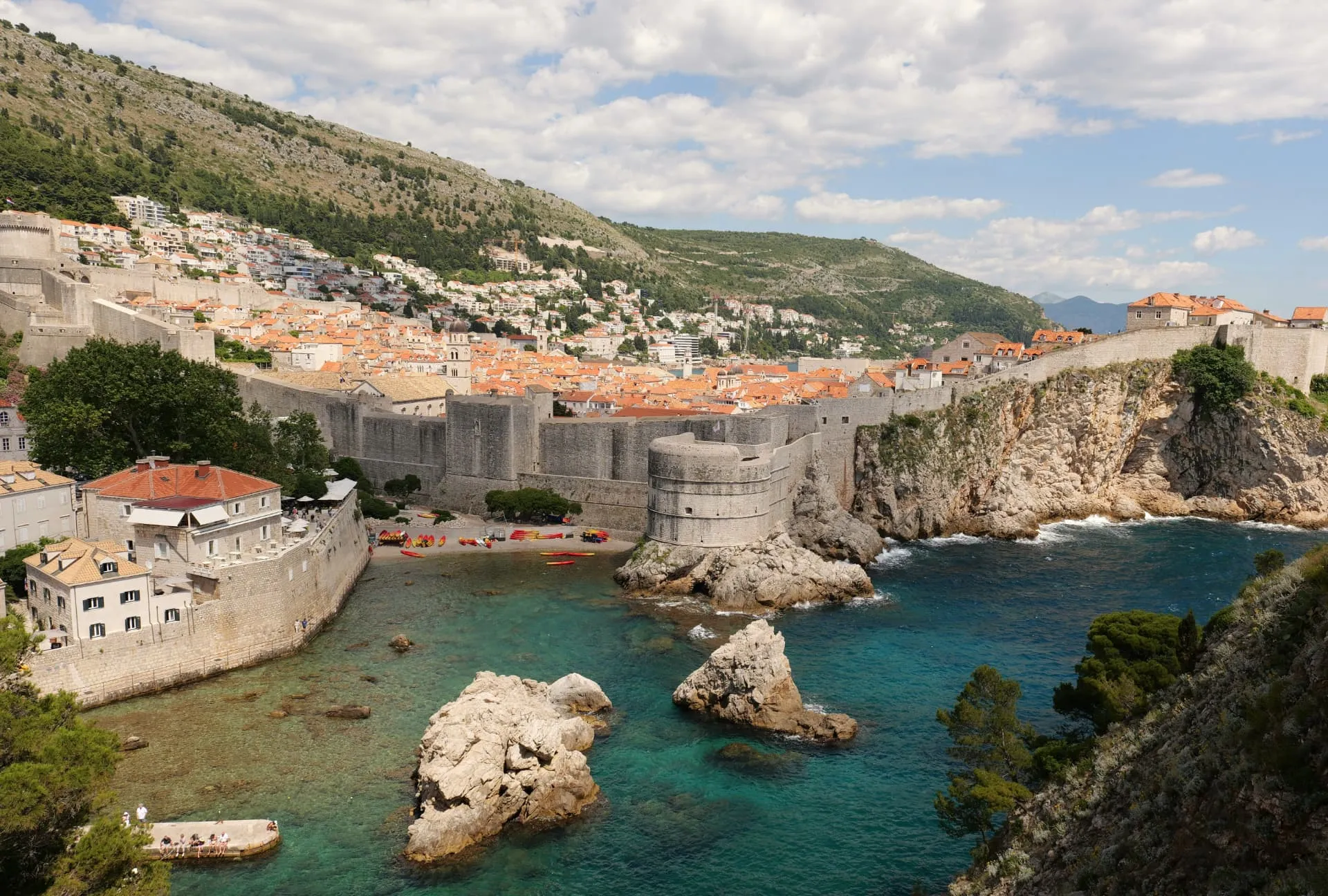
The walls run 1,940 metres around the Old Town, and walking them is the best way to understand how the city is laid out. Allow about 1.5 to 2 hours, and remember that the closing time is the last entry time. Full details are in our answer on City Walls tickets and opening hours.
2. Stradun (Placa)
The main street, officially called Placa and known to everyone as Stradun, is 298 metres long. At its western end, inside the Old Town close to the Pile Gate entrance, stands the Large Onofrio's Fountain, and at its eastern end the Small Onofrio's Fountain. Its plan was set by the city statute of 1272. The uniform Baroque houses, with shops at street level, date from the rebuilding after the earthquake of 1667, which destroyed many of the earlier Gothic and Renaissance palaces. Stradun is still the city's main shopping street and the venue for its major events.
3. Onofrio's fountains
Inside the Old Town, close to the Pile Gate entrance, stands the Large Onofrio's Fountain, a polygonal fountain with 16 carved stone masks that pour water. It was built in 1438, when the city's water supply was completed, bringing spring water from Rijeka Dubrovačka 12 km away. On the eastern part of Stradun, the Small Onofrio's Fountain (1446) sits in a niche on the City Guard building.
4. Orlando's Column, the Bell Tower and Sponza Palace
- Orlando's Column, carved under a contract from 1418 by Bonino of Milan, shows a medieval knight with a sword and is a symbol of the city's statehood. It carries the St Blaise banner during the Feast of St Blaise and the Libertas flag during the Dubrovnik Summer Festival.
- The City Bell Tower, with a clock from 1444. The bronze figures known as Zelenci strike the hours. The tower was rebuilt in 1929, and the original Zelenci are now in the Rector's Palace.
- Sponza Palace, west of the Bell Tower, a 16th-century Gothic-Renaissance palace that served as the customs house, mint and arsenal. Today it houses the Dubrovnik Archives.
5. Church of St Blaise
The Baroque Church of St Blaise, built between 1706 and 1715, is dedicated to the city's patron saint. Inside is the silver statue of St Blaise, which survived the fire of 1706 that destroyed the earlier church. The saint holds a model of the city that shows Dubrovnik's historic buildings. His feast on 3 February is also the official Day of the City of Dubrovnik. Entry to the church is free.
6. Rector's Palace
The Rector's Palace was the seat of government of the Dubrovnik Republic. The Rector lived here during his one-month term, and the palace also held council halls, a courtroom, prisons and a gunpowder store. Today it houses the Cultural History Museum, with period rooms, paintings, old coins of the Republic and the original Zelenci from the bell tower. The atrium is often used for concerts because of its acoustics.
Price: EUR 15 for adults, EUR 8 for schoolchildren and students, EUR 35 family ticket (up to two adults with their children aged 14 or younger). Children under 7 enter free. Hours: 09:00 to 18:00 every day from 1 April to 31 October; 09:00 to 16:00 from 1 November to 31 March, closed on Mondays.
7. Cathedral
Dubrovnik Cathedral, the Cathedral of the Assumption, was built between 1672 and 1713 on the site of an earlier Romanesque cathedral destroyed in the 1667 earthquake. Above the main altar is a 16th-century polyptych of the Assumption by Titian and his workshop. The cathedral treasury holds the head and arm reliquaries of St Blaise. Entry to the cathedral is free.
8. Franciscan Monastery
The Franciscan Monastery stretches from Stradun, next to the Church of St Saviour, towards Minčeta Fortress. Its construction began in 1317. Its late Romanesque cloister is among the finest of its era in Dalmatia, and the church holds the tomb of the poet Ivan Gundulić. The ticket covers the cloister and the monastery's Old Pharmacy.
Price: EUR 8 for adults, EUR 4 for pupils and students, free for children up to 7, and free with the Dubrovnik Pass. Hours: every day 09:00 to 18:00 in summer and 09:00 to 14:00 in winter. Closed on 1 January and 25 December, and on Sundays from 1 November to 1 April.
9. Dominican Monastery
Near Ploče Gate, the Dominican Monastery was begun in 1228 and built into the city walls as part of the defences. Its collection includes works of the 15th and 16th-century Dubrovnik school of painting, a 14th-century crucifix by Paolo Veneziano, and an altarpiece of St Mary Magdalene by Titian and his assistants from 1550.
10. The Synagogue
In Žudioska Street, the Dubrovnik Synagogue was built in 1408 by Jews who had come from Spain. It is the world's oldest active Sephardic synagogue and the second oldest synagogue in Europe.
11. The Jesuit Staircase and St Ignatius Church
The Baroque staircase from Gundulić Square up to the Church of St Ignatius was designed by Pietro Passalacqua in 1738. Game of Thrones fans know it as the setting for Cersei's Walk of Shame. The church above it, finished in 1725, is part of the finest Baroque complex in the city.
12. Gundulić Square market
Behind the Cathedral, Gundulić Square turns into a green market every morning, with fruit and vegetables from the surrounding villages. The statue of the poet Ivan Gundulić in the middle dates from 1892.
13. Prijeko
Prijeko runs parallel to Stradun towards the eastern side of the Old Town, and 14 steep side streets run down from it towards Stradun. Its houses have Gothic, Renaissance and Baroque portals, balconies and windows, and today it is the street with the largest number of restaurants in the Old Town.
14. The Old Port and Fort St John
The Old Port took its present shape in the 15th century. Fort St John, the harbour's main defence from attacks by sea, holds the Aquarium on the ground floor and the Maritime Museum on the first and second floors, and one of the entrances to the City Walls. The harbour and Porporela, next to Fort St John, are a pleasant promenade, and the boats to Lokrum leave from here.
Maritime Museum: EUR 10 for adults, EUR 7 for schoolchildren and students. Open 09:00 to 18:00 from April to October and 09:00 to 16:00 from November to March, closed on Wednesdays.
How much time do you need?
Local tip: one full day is enough for the Old Town, including the City Walls and a couple of museums.
Should you buy the Dubrovnik Pass?
The Dubrovnik Pass costs EUR 40 for one day, EUR 50 for three days and EUR 60 for seven days. It includes the City Walls with Fort Lovrijenac, the Rector's Palace, the Maritime Museum, the Ethnographic Museum, the Archaeological Exhibitions, the Franciscan Monastery Museum, the Marin Držić House, the Dubrovnik Natural History Museum, the Dubrovnik Art Gallery and several other galleries, plus free city buses. Each museum can be visited once, and children under 7 do not need a pass.
From March to November the 1-day pass costs the same as a City Walls ticket, so if you plan to walk the walls, the museums come at no extra cost.
Museum closures to know about
Dubrovnik Museums (the Rector's Palace, Maritime, Ethnographic and Archaeological museums) are closed on Christmas Day, New Year's Day and the Feast of St Blaise. On Christmas Eve and New Year's Eve they open from 09:00 to 12:00. Tickets at their ticket offices can only be paid by card.
Frequently asked questions
What are the must-see sights in Dubrovnik Old Town? The City Walls, Stradun, the Rector's Palace, Orlando's Column, Sponza Palace, the Church of St Blaise, the Cathedral and the Franciscan and Dominican monasteries.
How long do you need for Dubrovnik Old Town? One full day is enough.
Is the Cathedral free? Yes, entry to the Cathedral is free, and so is entry to the Church of St Blaise.
How much does the Rector's Palace cost? EUR 15 for adults and EUR 8 for schoolchildren and students. Children under 7 are free.
Can I pay cash at Dubrovnik museums? No. Dubrovnik Museums ticket offices accept card payments only.
Is the Dubrovnik Pass worth it for the Old Town? If you plan to walk the City Walls, yes. The 1-day pass costs the same EUR 40 as a walls ticket and adds the main museums and city buses.
Where was the Game of Thrones Walk of Shame filmed? On the Jesuit Staircase leading from Gundulić Square to the Church of St Ignatius.
Sources
Prices and opening hours change, so confirm on the official sites before you go.
- Dubrovnik Tourist Board, monuments (Placa, Onofrio's fountains, Orlando's Column, Luža and Bell Tower, Sponza, Rector's Palace, Gundulić Square, Prijeko, City Harbour, Fort St John)
- Dubrovnik Tourist Board, religious sites (Franciscan and Dominican monasteries, Cathedral, Treasury, Church of St Blaise, Synagogue, St Ignatius)
- Dubrovnik Tourist Board, Game of Thrones locations
- Franciscan Monastery (Mala braća), museum hours and ticket prices
- Dubrovnik Museums, entrance tickets
- Dubrovnik Museums, opening hours
- Dubrovnik Airport, Dubrovnik Pass prices and inclusions
- City Walls Dubrovnik, official webshop