Short answer
The bus runs all year and is the cheapest option: on the official Dubrovnik bus station timetable for 4 November 2026, buses took 3 hours 45 minutes to 4 hours 40 minutes and one-way fares started at around EUR 18. From April to October, fast passenger catamarans run by TP Line and Krilo sail between Split and Dubrovnik via Hvar and Korčula in 4 hours 30 minutes to 5 hours 25 minutes, for EUR 50 one way. By car, the A1 motorway and the coastal road over the Pelješac Bridge get you to Dubrovnik without crossing a border, in around 3 hours without traffic. There is no train to Dubrovnik. Every option works in both directions.
| Option | When | Journey time | One-way price |
|---|---|---|---|
| Bus | All year | 3 h 45 min to 4 h 40 min | From around EUR 18 |
| Catamaran (TP Line, Krilo) | April to October in 2026 | 4 h 30 min to 5 h 25 min | EUR 50 adult |
| Car | All year | Around 3 hours without traffic | Fuel and motorway tolls |
By catamaran (April to October)
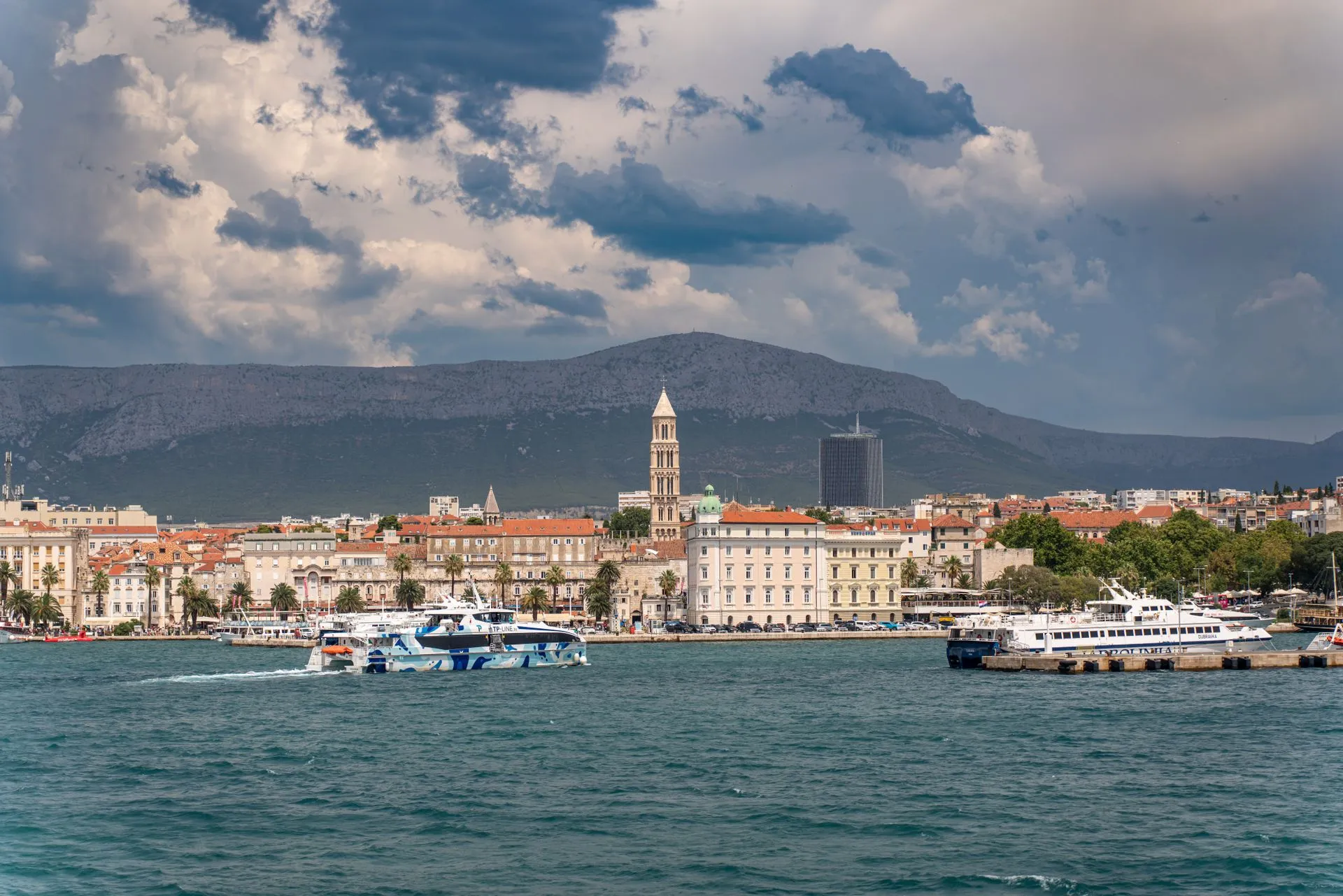
The catamarans are passenger-only and stop at the islands on the way, which makes the trip a sightseeing cruise in its own right. In Dubrovnik they arrive at the ferry port in Gruž. These were the 2026 timetables:
Split to Dubrovnik
| Operator | Season 2026 | Leaves Split | Arrives Dubrovnik | Stops |
|---|---|---|---|---|
| Krilo | 1 April to 31 October, daily | 08:00 | 12:40 | Milna (Brač), Hvar, Korčula, Pomena (Mljet) |
| TP Line 654 | 8 May to 18 October, daily | 09:00 | 14:15 | Milna (Brač), Hvar, Korčula |
| TP Line 842 | 1 April to 31 October, daily | 15:10 | 20:20 | Milna (Brač), Hvar, Korčula |
Dubrovnik to Split
| Operator | Season 2026 | Leaves Dubrovnik | Arrives Split |
|---|---|---|---|
| TP Line 842 | 1 April to 31 October, daily | 08:00 | 13:25 |
| TP Line 654 | 8 May to 18 October, daily | 14:55 | 20:00 |
| Krilo | 1 April to 31 October, daily | 15:30 | 20:00 |
On TP Line 842, 1 April 2026 had departures from Split only and 31 October 2026 from Dubrovnik only.
Prices. Split to Dubrovnik costs EUR 50 one way with both operators. On TP Line, children aged 3 to 12 pay 50% of the ticket price, children aged 1 to 3 travel free with a ticket, and the price is the same in both directions. Krilo charges EUR 20 from Pomena on Mljet and EUR 25 from Korčula to Dubrovnik.
Local tip: in summer, take the catamaran if comfort matters most. It is a more relaxed journey than the bus, with sea views and stops on the islands.
Good to know. Krilo asks passengers to be at the boarding point at least 15 minutes before departure. In bad weather, Krilo's stop at Pomena can be moved to Sobra on the same island. Timetables change every season, so check the current one with the operator before you plan.
By bus (all year)
Buses run between Split and Dubrovnik all year, operated by several companies, including FlixBus, Autotrans, Promet Makarska and Samoborček. In Dubrovnik they use the main bus station in Gruž.
On the official Dubrovnik bus station timetable for Wednesday 4 November 2026, buses from Dubrovnik to Split left at 08:00, 14:15, 18:00, 21:00 and 22:00 and took 4 hours to 4 hours 40 minutes. One-way fares ranged from EUR 17.73 to EUR 32.93, depending on the company and fare type. Buses from Split to Dubrovnik took between 3 hours 45 minutes and 4 hours 30 minutes, with fares from EUR 18.52.
You can buy tickets on the Dubrovnik bus station website, where online tickets must be bought at least two hours before departure, or at the station ticket office.
Not every long-distance bus takes the same road. The Dubrovnik bus station timetable also lists lines that run via Neum, in Bosnia and Herzegovina.
Local tip: before you buy, check with the bus company whether your bus goes over the Pelješac Bridge or via Neum. If it goes via Neum, you cross the border twice, so keep your passport with you.
Local tip: from Split to Dubrovnik, sit on the right-hand side of the bus for the sea views.
By car
The Dubrovnik Tourist Board's advice is to take the A1 motorway through Croatia and then the Adriatic Highway along the coast for the final stretch. The Pelješac Bridge connects southern Dalmatia directly with the rest of Croatia, so the drive no longer involves a border crossing.
Local tip: without traffic, the drive takes around 3 hours.
Driving into the Old Town is restricted, and parking near the historic centre is limited. If you arrive by car, choose accommodation with parking. See where to stay in Dubrovnik.
Frequently asked questions
What is the best way to get from Split to Dubrovnik? From April to October, the catamaran is the most scenic, with stops at Hvar and Korčula for EUR 50. The bus is cheaper, from around EUR 18, and runs all year.
Is there a ferry from Split to Dubrovnik? Yes, from April to October. TP Line and Krilo run daily fast catamarans for EUR 50 one way.
How long is the ferry from Split to Dubrovnik? 4 hours 40 minutes with Krilo and 5 hours 10 to 15 minutes with TP Line, on the 2026 timetables.
How long is the bus from Split to Dubrovnik? Between 3 hours 45 minutes and 4 hours 40 minutes on the November 2026 timetable.
How much is the bus from Split to Dubrovnik? One-way fares started at around EUR 18 on the official timetable in November 2026.
Do you cross a border driving from Split to Dubrovnik? No. The Pelješac Bridge lets you drive to Dubrovnik without crossing a border.
Does the bus from Split to Dubrovnik cross a border? It depends on the bus. Some lines run via Neum in Bosnia and Herzegovina, so check the route with the bus company and carry your passport.
Is there a train from Split to Dubrovnik? No. No trains run to Dubrovnik, so take the bus, the catamaran or a car.
How long is the drive from Split to Dubrovnik? Around 3 hours without traffic.
Is there a ferry from Split to Dubrovnik in winter? Not on the 2026 timetables, which ran from April to October. In winter, take the bus or drive.
Where does the ferry arrive in Dubrovnik? At the ferry port in Gruž, not in the Old Town.
Sources
Timetables and fares change by season, so check with the operators before you travel.
- TP Line, line 654 Split - Dubrovnik, sailing schedule 2026 (PDF)
- TP Line, line 842 Dubrovnik - Split, sailing schedule 2026 (PDF)
- Krilo, sailing schedule and prices
- Dubrovnik main bus station, timetable Dubrovnik to Split
- Dubrovnik main bus station, timetable Split to Dubrovnik
- Dubrovnik main bus station, online tickets
- Dubrovnik Tourist Board, arrival (ferries from Split, A1 motorway, Pelješac Bridge, buses)
- Dubrovnik Tourist Board, getting around the city (traffic zone and parking)